Loading...
Serving Soledad, CA and surrounding areas. (831) 315-4388
Faster curing, UV-resistant, and built to handle Salinas Valley heat - polyaspartic coatings are ready for foot traffic in hours and vehicles within 24 hours.
Polyaspartic floor coatings in Soledad bond directly into the concrete surface and cure in hours instead of days - most garages are ready for vehicles within 24 hours. The system also resists UV light and high-heat environments better than standard epoxy, which matters in Salinas Valley summers where garage temperatures climb past 90 degrees by midday.
If you have been looking at flooring options and are not sure whether polyaspartic or epoxy is right for your situation, our garage floor coatings page covers both systems side by side. The short version: polyaspartic wins on cure speed and UV resistance; standard epoxy is often the more cost-effective choice when neither factor is a priority.
Like all polyaspartic floor coatings, the quality of the result comes down almost entirely to how well the concrete was prepared before anything was applied. We mechanically grind every floor, test for moisture - critical in older Soledad homes - and repair cracks before the first coat goes down. That preparation is what separates a coating that lasts 15 years from one that peels in two.
If your current garage floor has yellow patches where the car usually parks or where sunlight streams in, that is UV-degraded epoxy. Polyaspartic coatings are engineered to hold their color under direct UV exposure, even through years of California sun.
If you run your hand across the floor and it comes back gray, the concrete is unsealed and breaking down. Soledad homeowners deal with both concrete dust and agricultural dust - a polyaspartic coating seals the surface completely and eliminates both sources of grit.
Standard epoxy can keep your garage off-limits for 72 hours or more. If you work from home, have tools you need daily, or just cannot afford a long disruption, polyaspartic's 24-hour vehicle readiness is a real advantage.
Soledad's spring winds and winter rains blow fine dust and moisture into garages, making bare concrete slippery. Polyaspartic coatings with decorative flakes add a slight texture that improves traction even when the floor is damp.
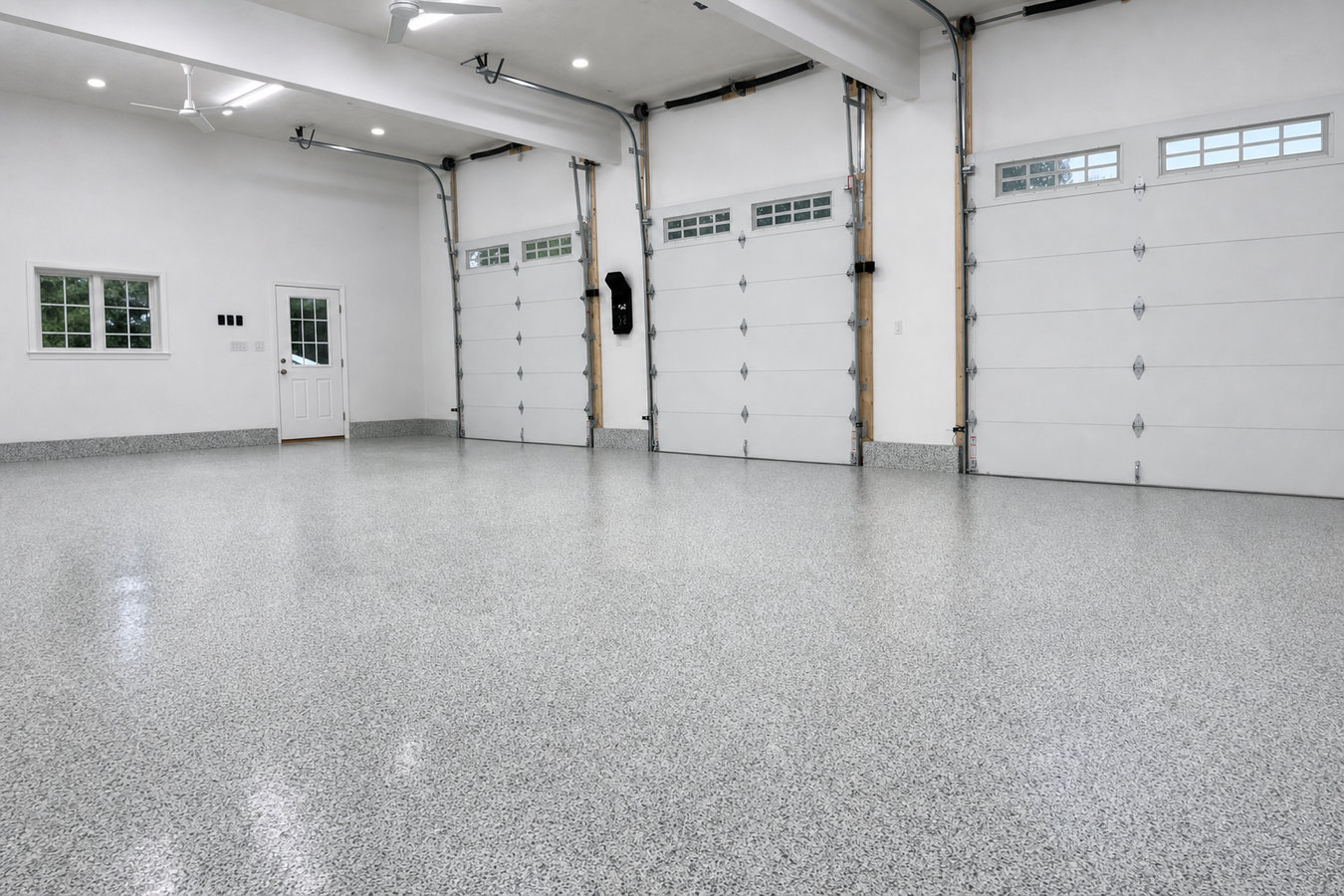
Every polyaspartic job we install follows the same foundation: mechanical surface preparation, moisture testing, crack repair, and a multi-layer coating application with a UV-stable clear topcoat. What varies is the decorative finish. Most homeowners choose to add colored flakes broadcast into the wet base coat - they add a granite-like texture, help hide dust and dirt between cleanings, and improve traction underfoot. Solid colors and metallic finishes are also available for homeowners who want a cleaner, more uniform look.
Polyaspartic is also available as an upgrade topcoat over an epoxy base - a hybrid approach that uses epoxy for the base color and polyaspartic for the UV-stable, fast-curing finish layer. For garages that see heavy use or a mix of foot and vehicle traffic, this combination offers strong durability and a long-lasting surface. If your project involves a larger commercial or workshop space, see our metallic epoxy flooring options and our full range of garage floor coating systems.
The most popular polyaspartic option - colored flakes fully cover the base coat for a consistent, slip-resistant surface that hides dirt well.
A clean, minimal look for workshops, utility garages, or commercial spaces where a uniform surface matters more than decorative texture.
A hybrid system combining epoxy's cost-effectiveness with polyaspartic's UV resistance and faster final-coat cure time.
The Salinas Valley climate creates two specific problems for standard epoxy in residential garages: UV degradation and heat sensitivity. Soledad summers push temperatures well past 90 degrees, and sunlight streams into most attached garages for hours each day. Standard epoxy softens under hot tires and yellows from UV exposure. Homeowners across Soledad and neighboring Prunedale who have seen yellow patches develop on epoxy floors are looking at exactly this problem. Polyaspartic is formulated specifically to resist both - the color stays true and the surface stays bonded even after years of California sun.
Older Soledad homes present another challenge: slabs without modern vapor barriers can allow moisture to wick up through the concrete, especially during the winter rain season and in neighborhoods where agricultural irrigation keeps the ground wet year-round. Moisture under a coating is the leading cause of delamination - where the coating lifts away from the floor. We test every slab for moisture before starting and, when needed, apply a moisture-blocking primer coat. That step adds time and cost, but skipping it is how a coating fails by the end of its first rainy season.
We respond within 1 business day. We will ask a few quick questions - floor size, space type, any visible cracks or prior coatings - then schedule a free on-site visit. A quote given without seeing the floor in person is not reliable.
We assess the concrete condition, test for moisture, and check any cracks or damage. You get a written estimate that covers all prep, repairs, and coating layers. No line items appear on the final invoice that were not in the estimate.
The crew mechanically grinds the floor, repairs cracks and divots, and applies a moisture primer if the slab reading is high. This is the most time-consuming step and the most important one. Rushing it is the reason most coatings fail.
Base coat, flakes, and topcoat go down in sequence. The garage stays closed while the coating cures. Most polyaspartic systems are walkable within a few hours and ready for your vehicle within 24 hours. We walk the floor with you before we leave.
We respond within 1 business day. No obligation - just a free on-site estimate that covers prep, any needed repairs, and all coating layers. Someone from our office will call to schedule a time that works for you.
(831) 315-4388The Salinas Valley's irrigation-heavy soil keeps ground moisture elevated, especially under older slabs. We test before any coating goes down. If the reading is high, we apply a moisture-blocking primer - the step that prevents bubbling and delamination.
Polyaspartic coatings need to be applied within a specific temperature range to cure correctly. We schedule application during cooler morning hours in summer, when garage temperatures are manageable and the coating can set without trapping bubbles.
You get a written estimate covering all prep, repairs, and coating layers after the on-site visit. No price surprises mid-job. If something unexpected comes up during prep, we tell you before we proceed - not after the fact.
We grind every floor mechanically before applying any coating. Acid etching alone does not create the surface profile needed for a long-lasting polyaspartic bond. Skipping this step is the single most common reason coatings fail within two years.
The difference between a coating that looks good in ten years and one that is peeling by year two comes down to preparation and product selection. The Concrete Network documents why polyaspartic outperforms standard epoxy in high-UV and high-heat environments - and the City of Soledad building requirements, referenced through the City of Soledad Building Department, confirm that residential floor coating work does not require a permit in most cases, but the contractor must hold a valid California license.
A decorative, high-gloss finish with a flowing, marbled appearance - ideal for showrooms, home studios, or garages where the floor is part of the design.
Learn MoreThe full range of garage floor coating systems, including epoxy, polyaspartic, and flake options, with an explanation of which suits each situation.
Learn MoreCall today or submit a request - we respond within 1 business day and come to your Soledad home for the on-site assessment.